AI agents are often framed as a model problem: choose a stronger model, write a better prompt, and expect better results. That approach can produce an impressive demo, but it rarely produces a dependable product.
A production-ready agent is not just a model. It is an engineered system that gives the model the right context, connects it to tools, tracks progress, handles failure, controls permissions, preserves useful memory, and keeps the work moving toward a concrete outcome.
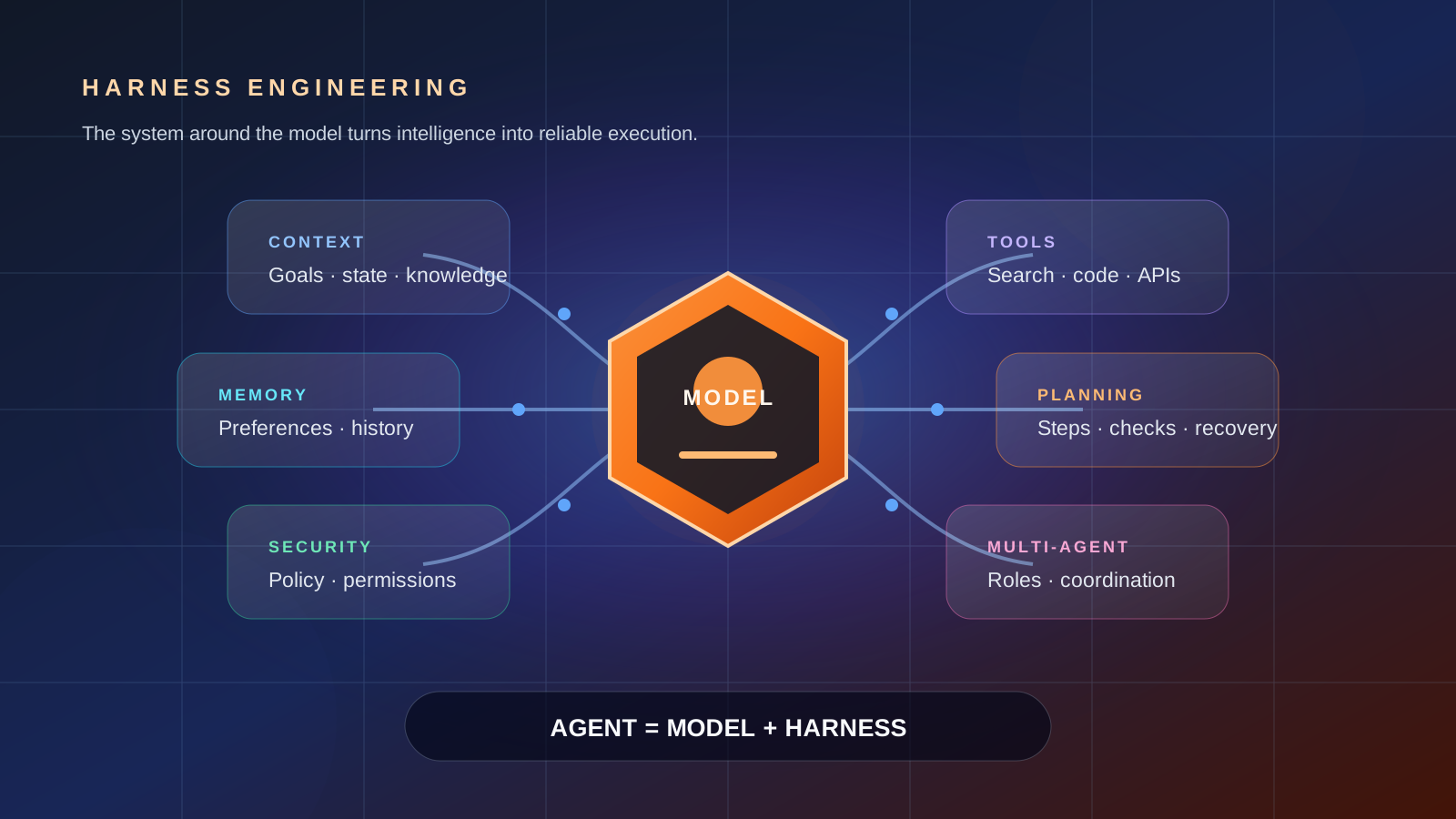
Agent = Model + Harness
The model is the reasoning engine. The harness is everything that allows that intelligence to operate reliably in the real world. Without a harness, a model can answer questions. With a well-designed harness, an agent can plan, act, inspect results, recover from mistakes, and complete an entire workflow.
From prompt engineering to context engineering
Prompt engineering focuses on the instructions given to a model. Context engineering takes a wider view: it manages every piece of information the model needs at each stage of the task.
That context can include:
- the user's goal and success criteria;
- conversation history and previous decisions;
- tool outputs and external knowledge;
- the current task state and remaining steps;
- user preferences, policies, and constraints;
- the execution environment, available resources, and recent failures.
The challenge is not simply collecting more information. It is selecting the right information, introducing it at the right moment, and presenting it in a form the model can use. Too little context leads to shallow or incorrect decisions. Too much context increases cost, slows the system down, and makes important constraints easier to miss.
This matters directly in AI products. A user asking for an image, video, song, or marketing asset may provide only one sentence, but a good system can also consider previous style preferences, template parameters, generation history, failed attempts, available credits, brand rules, and the current stage of the workflow. The model call is only one component of that experience.
Agents should complete tasks, not just answer questions
The clearest difference between a chatbot and an agent is not response length. It is the ability to continue acting around a goal.
A useful agent generally needs five capabilities:
- Intent understanding: identify what the user is actually trying to achieve, including hidden constraints and expected deliverables.
- Planning: break a complex objective into steps that can be executed and checked.
- Tool use: search, access files, run code, query data, operate software, and call external services.
- Reflection and recovery: inspect results, recognize failure, diagnose the cause, and revise the plan.
- Human approval: pause before high-impact actions such as publishing, deleting, paying, or changing production settings.
Consider competitive analysis. A chatbot can explain how to analyze competitors. An agent can gather competitor information, extract positioning, compare pricing, organize evidence, produce a report, and turn the findings into product recommendations. The value comes from closing the loop, not generating a longer explanation.
The same applies to analytics. Instead of merely describing what a chart might mean, an agent can access the dataset, detect anomalies, investigate likely causes, summarize the evidence, and recommend next actions.
Memory and Skills make agents product-ready
Memory addresses one of the most frustrating limitations of AI products: starting from zero every time. A strong agent should retain useful preferences, project background, recurring rules, and decisions from previous tasks.
But memory cannot be an unlimited archive copied into every request. That creates context pollution, raises cost, increases latency, and can cause outdated information to override the user's current intent. A memory system therefore needs to answer two questions:
- What is important enough to preserve?
- When is that information relevant enough to retrieve?
Skills solve a different problem: capability modularity. A Skill is a focused package of instructions, resources, and procedures for a particular type of work. The system loads the relevant capability when the task requires it instead of placing every possible instruction into every context window.
For an AI application, separate Skills might handle video-prompt optimization, image-style recommendations, lyric adaptation, app-review responses, campaign analysis, or weekly reporting. This makes the agent more specialized while keeping the active context smaller and easier to control.
The real engineering lives around the model
Agent reliability does not come from model intelligence alone. It comes from the surrounding infrastructure that turns uncertain model behavior into a controlled execution process.
A practical harness usually includes:
- Context construction: assemble goals, state, history, policies, retrieved knowledge, and tool results.
- Tool registration and routing: expose only the tools relevant to the current task and validate their inputs.
- Task state: track completed work, pending steps, dependencies, and acceptance criteria.
- Result handling: normalize tool outputs and return only useful evidence to the model.
- Retries and recovery: distinguish temporary failures from flawed plans and choose the right response.
- Persistence: checkpoint long-running work so it can resume after interruptions.
- Permissions and policy: limit what the agent can access and require approval at sensitive boundaries.
- Multi-agent coordination: divide independent work, prevent conflicting edits, and combine results.
- Context compression: summarize long histories without losing goals, constraints, or unresolved risks.
These components may look less exciting than a new model release, but they determine whether an agent can survive production conditions. A demo can succeed with a carefully prepared prompt. A product must also handle bad inputs, unavailable services, partial results, permission boundaries, cost limits, audit logs, and users who change their minds halfway through a task.
Practical lessons for AI product teams
1. Design the workflow, not just the model call
When designing an AI feature, do not stop at “Can the model generate this?” Ask whether the context is sufficient, the toolchain is complete, the failure path is recoverable, and the user can move from intent to finished outcome.
Video generation is a useful example. The model is only one step. The full experience may include template selection, asset upload, prompt improvement, credit checks, progress tracking, failure recovery, completion notifications, and post-generation editing. Every one of those steps belongs to the harness.
2. Start with internal productivity workflows
Internal tools are often the best place to introduce agents. Their goals are clearer, the data is more concentrated, and teams can tolerate more iteration while the system improves.
Strong starting points include competitive-research agents, app-review response agents, weekly analytics agents, content-operations agents, and crash-analysis agents. Each has a bounded objective, identifiable tools, and outputs that a human can verify.
3. Move from generation features to outcome-oriented assistants
Many AI products are still organized around a single generation event: make an image, produce a video, create music, or draft copy. The more valuable direction is to organize the experience around a completed user goal.
A user may not truly want one image; they may need a complete set of campaign assets. They may not want one song; they may want a publishable music video. They may not want one paragraph of copy; they may want everything required to launch a campaign. Agents become more valuable when the product owns that broader workflow.
Harness engineering turns intelligence into a product
Models provide the foundation for intelligence, but the harness makes that intelligence controlled, useful, and operational.
The teams building the strongest agent products will not focus only on model access or prompt quality. They will invest in context management, tools, memory, task state, recovery, permissions, observability, and complete product workflows.
A prompt can help a model produce a better answer. A harness helps an agent get the job done.