
B.AI

A multi-model AI gateway with browser chat, APIs, wallet login, crypto payments, and Web3 agent infrastructure.

4.0/ 5

About B.AI

B.AI is a Web3-oriented AI platform built around two everyday needs: accessing multiple large language models from one interface and paying for AI usage with crypto-native accounts. Instead of asking users to maintain separate subscriptions and API keys for every model provider, it presents a shared chat and API layer alongside agent-focused payment, identity, and developer components.

B.AI launch graphic describing financial infrastructure for AI agents
B.AI positions the platform as financial and access infrastructure for the AI-agent economy. Image source: B.AI launch coverage on KuCoin.

One interface for many AI models

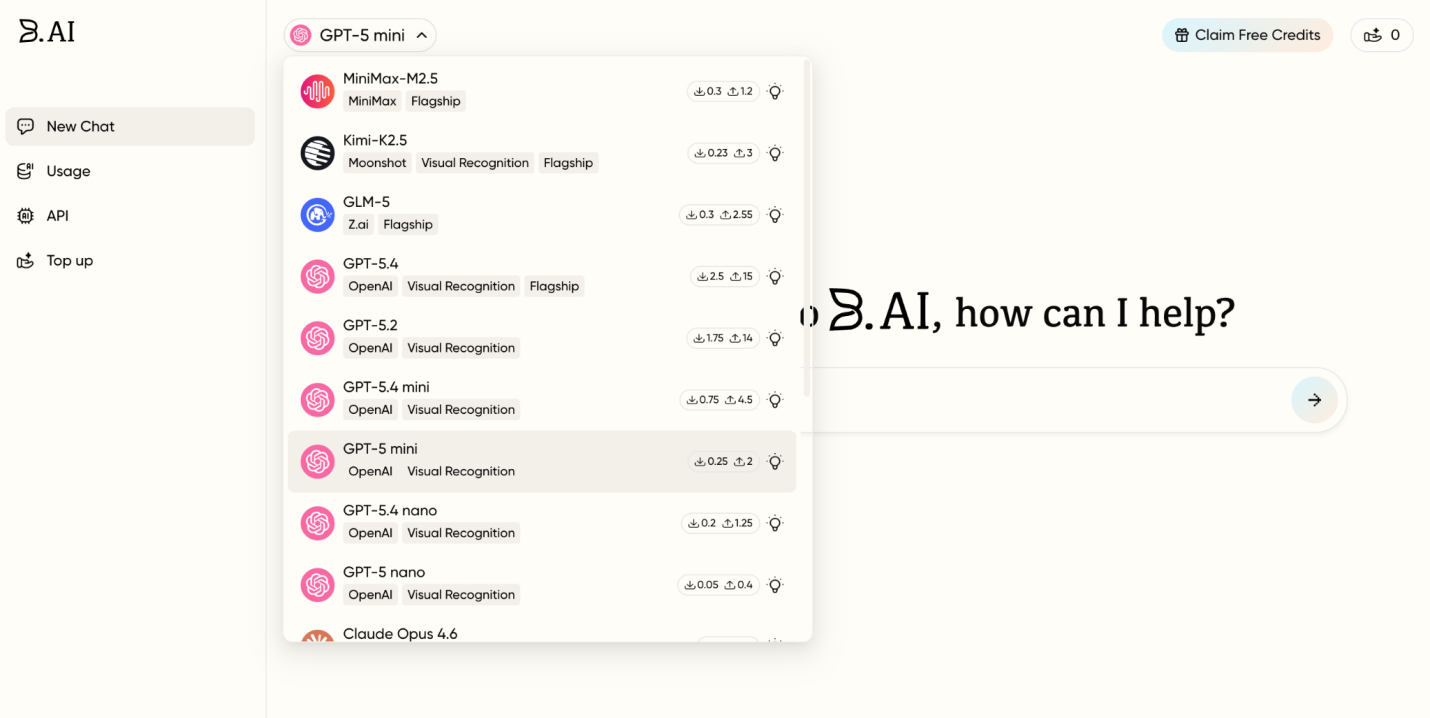
For a normal user, the simplest route is the browser chat: sign in, open a new conversation, choose a model, and submit a prompt. The model menu shown in B.AI launch material includes options from providers such as OpenAI, Anthropic, MiniMax, Moonshot AI, and Z.ai. This makes B.AI closer to a multi-model gateway than a single proprietary chatbot. Model availability and credit rates can change, so the live selector is the reliable place to check what is currently offered.

B.AI chat interface with a menu for selecting GPT, Claude, Kimi, MiniMax, and GLM models
The B.AI chat interface lets users switch between supported model families before starting a task. Image source: B.AI launch coverage on KuCoin.

Wallet login and crypto payments

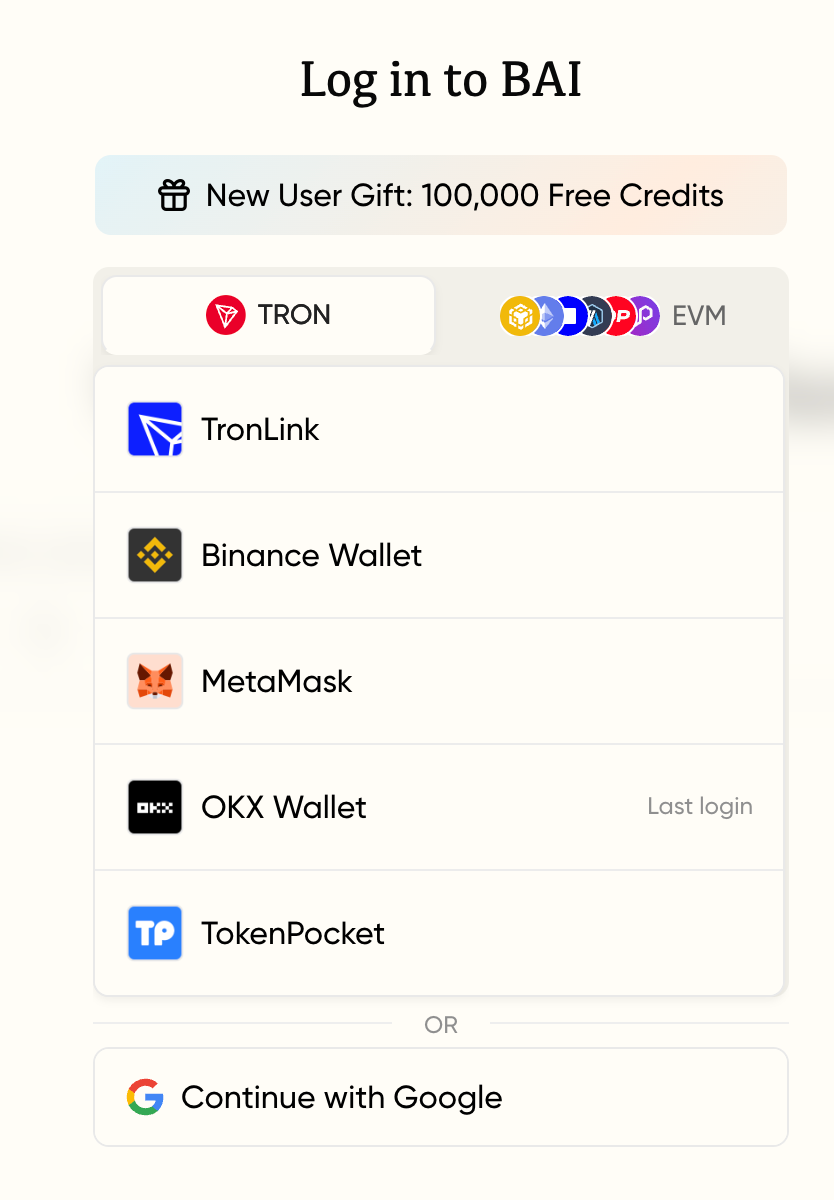
B.AI supports conventional Google sign-in as well as wallet-based login. Its launch interface shows TRON and EVM-compatible wallet routes, including TronLink, Binance Wallet, MetaMask, OKX Wallet, and TokenPocket. That is useful for Web3 teams that already hold operational funds on-chain and want to buy credits or connect agent services without introducing a separate card-based billing workflow. Users should still verify the destination, permissions, chain, and amount before approving any wallet action.

B.AI login screen listing TronLink, Binance Wallet, MetaMask, OKX Wallet, and TokenPocket
B.AI offers wallet-based sign-in across TRON and EVM networks, alongside Google login. Image source: B.AI launch coverage on KuCoin.

Agent infrastructure beyond chat

The broader product direction includes a unified LLM API, BAIclaw, reusable Skills, an MCP server, agent wallets, and Web3 protocols for identity and machine-to-machine payment. Those pieces are aimed primarily at developers building agents that must authenticate, call models, pay for services, or receive payment. The practical appeal is strongest when an application genuinely needs both AI and on-chain settlement; a conventional model provider may remain simpler for an ordinary non-crypto app.

Justin Sun connection: association, not confirmed founder status

B.AI is often discussed alongside the TRON ecosystem, and Justin Sun publicly amplified the project's launch. Sun is the founder of TRON, but the primary sources reviewed by AI List 101 do not identify him as the founder of B.AI. That distinction matters: an ecosystem connection or public endorsement is not proof of ownership or authorship. Until B.AI publishes a named founding team, claims that Sun created the product should be treated as unconfirmed.

Overall, B.AI is most interesting as a crypto-native model gateway and agent payment layer. Try it first with a small amount of credit, compare its current model pricing and latency against direct providers, and avoid granting broader wallet permissions than the task requires.

B.AI Review

A practical review based on pricing, features, strengths, limitations, and ideal users.

Overview

B.AI is a Web3-oriented multi-model AI gateway with browser chat, API access, wallet login, crypto payments, and infrastructure components for autonomous agents. Its strongest differentiator is not a proprietary foundation model; it is the attempt to combine model access with on-chain identity and payment rails.

Key Features

  • Multi-model chat and API access through one account
  • Support for conventional sign-in and TRON or EVM wallet login
  • Crypto-native credit purchase and agent payment workflows
  • Developer components including BAIclaw, Skills, MCP, and agent wallets
  • Web3 identity and machine-to-machine payment integrations

Pros

  • Convenient model switching for users who do not want separate provider accounts
  • Wallet login and crypto payment options fit Web3-native teams
  • Browser chat provides a low-friction way to test the service before integrating the API
  • Broader agent infrastructure may reduce integration work for crypto applications

Cons

  • The platform and its wider agent ecosystem are still new
  • Model availability, credit rates, and performance can change quickly
  • A gateway adds another service between the user and the original model provider
  • Wallet-based workflows introduce signing, permission, and smart-contract risk

Who It's For

B.AI is best suited to Web3 developers, agent builders, and crypto-native teams that need both multi-model AI access and on-chain payments. People who only need a mainstream chatbot may find a direct model provider simpler.

Verdict

B.AI has a coherent Web3 use case: give people and software agents one place to access models and settle usage on-chain. Start with a small credit balance, compare latency and output quality with direct providers, and grant the minimum wallet permissions possible. Justin Sun's public promotion and the TRON ecosystem connection are noteworthy, but primary sources do not establish him as B.AI's founder.

Category Context

Find autonomous AI agents and workflow copilots that can plan, execute, and coordinate multi-step tasks.

There are 63 tools in AI Agents on AI List 101.

Related Tools