NVIDIA Nemotron 3.5 Transcribe
Transcribe and analyze recorded audio with a downloadable model controlled through natural-language instructions.
An audio analysis API that answers custom questions about recordings with structured probabilities and event time spans.
Visit website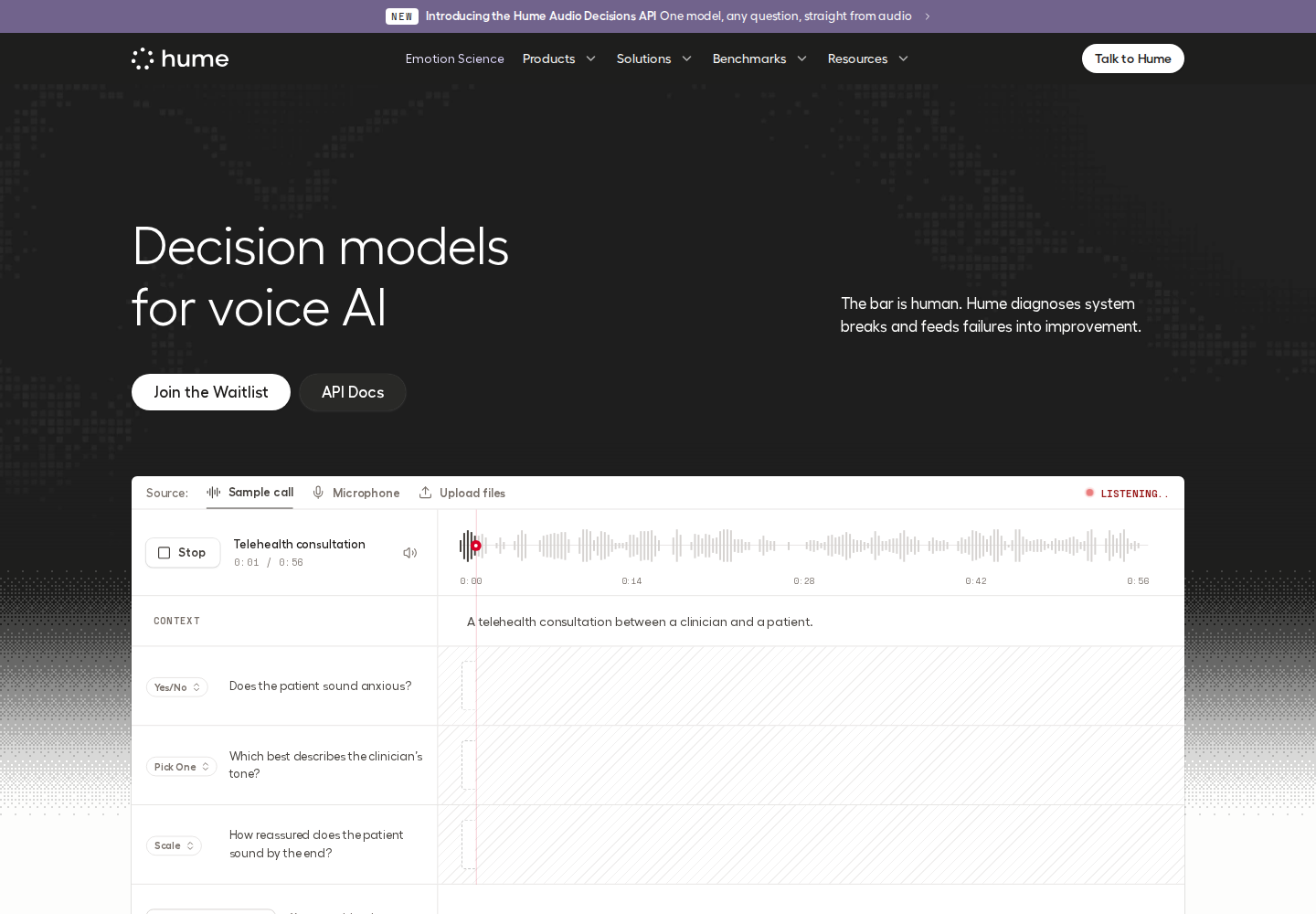
Hume Audio Decisions API accepts a recording and questions written in plain language, then returns structured probabilities. Questions can concern speech delivery, spoken content or other audible events. It is designed for tasks such as evaluating synthetic speech, testing voice agents, reviewing support calls and labeling speech datasets.
The API returns numerical judgments rather than a transcript, conversational response or explanation. Application code decides how to threshold, rank or combine the answers. Hume's product page offers an interactive demonstration with sample audio, microphone input and uploads, alongside a waitlist for API access.
Ask about how speech sounds, what a speaker says or audible events such as background noise.
Receive a probability for a yes/no judgment or a probability distribution across unordered answer options.
Define ordered levels for a quality such as naturalness and receive a probability for each level.
Ask when an event occurs and receive intervals where it may be present in the recording.
Python and TypeScript SDKs provide typed requests and responses, retries and helpers for splitting longer recordings.
Estimate input tokens before submitting a decision request. Estimation is not billed but counts toward request limits.
Compare recordings against a consistent set of naturalness and delivery questions.
Use custom judgments to identify recordings for closer human review.
Apply defined questions across a speech dataset and inspect ambiguous results.
Find relevant audible events within test recordings for follow-up analysis.
Usage is billed by input tokens covering audio, questions and context; answers are not billed. Approved organizations receive trial credit. No-commitment usage and Enterprise arrangements are available. Audio duration, including silence, contributes to usage.
Check current pricing ↗No. It returns structured judgments for application code to interpret.
Split them into recordings of five minutes or less, keeping each part at least five seconds long. Each part is sent separately.
Hume recommends relaying browser requests through a controlled server so the API key is not exposed in client-side code.
Input-token estimation, listing runs and retrieving runs are not billed. Successful decision requests are billed for their input tokens.