NVIDIA Nemotron 3.5 Bolt 74B-A9B 24GB
A downloadable vision-language model for local agents, combining quantized weights, configurable reasoning, and tool calling.
A downloadable English reasoning model with adjustable inference loops, long context, and local tool-calling APIs.
Visit website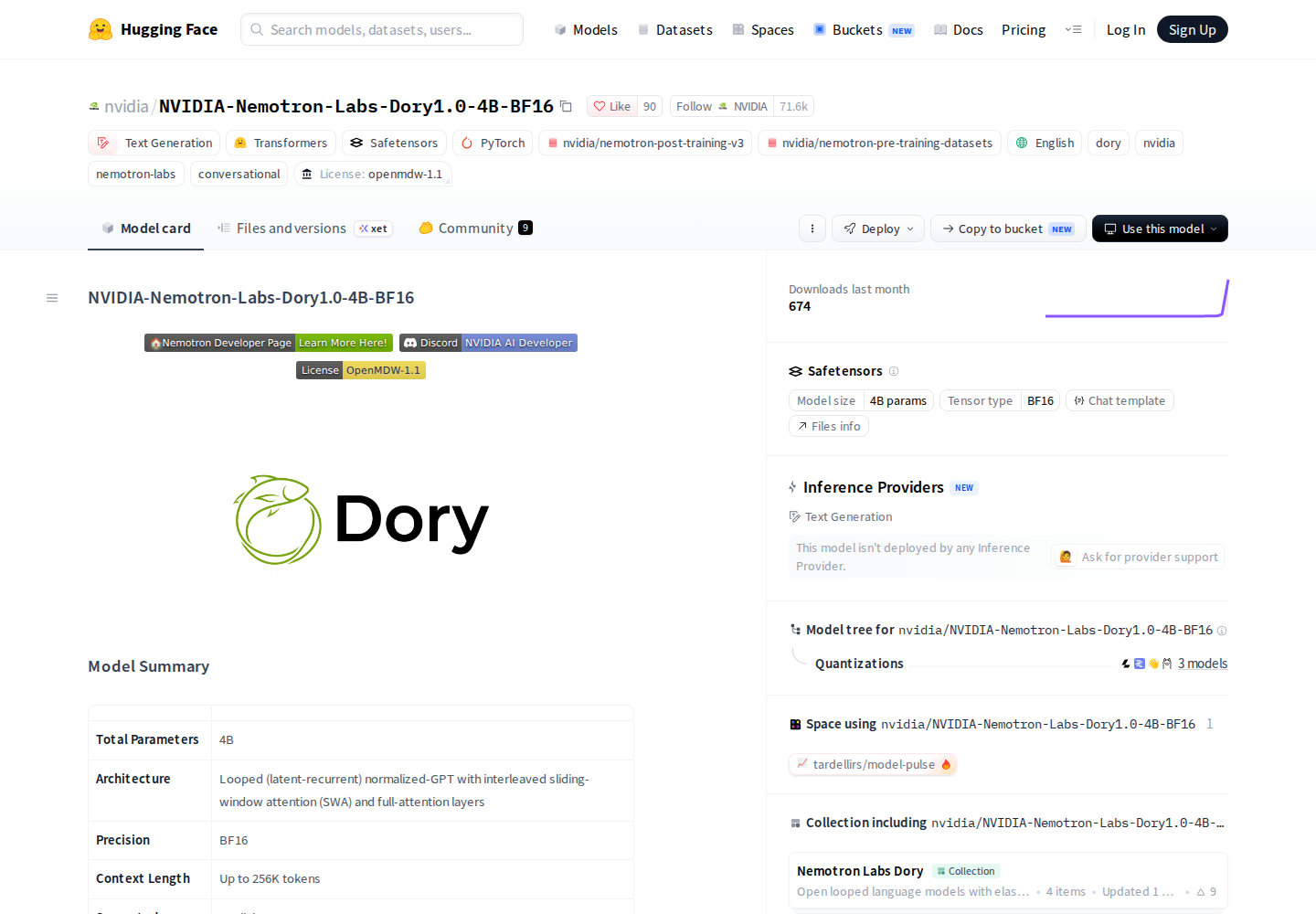
NVIDIA Nemotron Labs Dory1.0-4B is a downloadable, four-billion-parameter model for English text reasoning and generation. It serves developers and researchers building text applications, evaluating coding assistance, and integrating applications that request external tools.
Its distinguishing control is a looped architecture that repeatedly applies shared layers. Developers can change the computation spent on each token using the same checkpoint, making it useful for comparing reasoning settings before choosing a deployment configuration.
Changing the recurrent loop count adjusts inference computation without retraining or replacing the model. The architecture reuses a shared block of layers.
The model supports up to 256K tokens of context. Deployment settings may use a smaller window to accommodate available memory and concurrency.
The deployment examples expose an OpenAI-compatible API for chat, streaming responses, and tool-call requests, with runtime-specific parser or chat-template settings.
NVIDIA provides BF16, MXFP8, NVFP4, and Q5_K_M GGUF versions for compatible inference environments.
The llama.cpp integration offers separate caches per loop or a shared last-loop cache. Last-loop caching reduces cache memory but changes predictions and is sensitive to prefill chunk size.
Compare answer quality and response time across loop settings on a consistent evaluation set.
Assess the model on code explanation and repository questions before integrating it into a development workflow.
Connect a local text application to selected functions and evaluate its tool-call requests.
Model-material permissions are free under OpenMDW 1.1. Hardware and hosting are separate costs; redistribution requires retaining the agreement and applicable notices.
Check current pricing ↗NVIDIA recommends two loops initially. Compare end-to-end latency on your workload before increasing the count, because additional computation can also change output length.
NVIDIA provides a native ARM64 Apple Silicon recipe using GGUF and a pinned Dory-enabled llama.cpp build. That recipe excludes Intel Macs and Rosetta.
Yes. NVIDIA permits commercial and noncommercial use under OpenMDW 1.1, subject to the license terms.