NVIDIA Nemotron 3.5 Embed 8B
Create multilingual embeddings for semantic search across document text, page images and combined image-text content.
Generate protein sequences and all-atom structures from molecular design constraints.
Visit website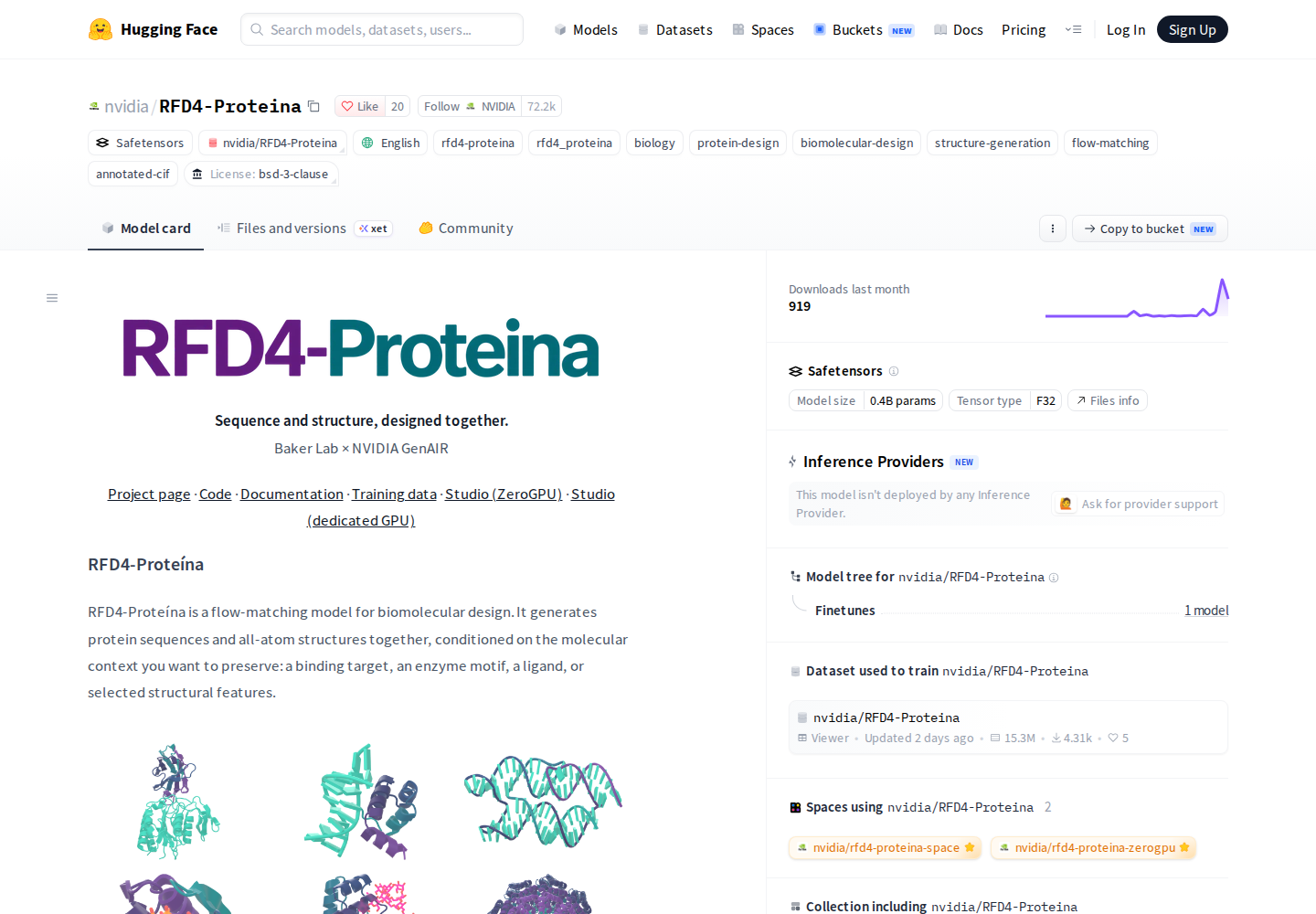
RFD4-Proteína is a downloadable biomolecular design model that jointly generates protein sequences and all-atom structures. It accepts annotated CIF structures or YAML conditions and returns CIF designs.
For protein engineers and computational biologists, examples cover unconditional monomer generation, protein binders and enzyme motif scaffolding.
Generate residue identities and atomic coordinates together.
Mark structural regions to preserve or design.
Start from examples for protein binders, enzyme scaffolds or unconditional monomers.
Guide inference-time search with geometric and energy evaluations, while recurrent refinement allocates additional computation.
Generate candidate binders around a specified target for subsequent evaluation.
Explore protein designs around a catalytic motif.
Integrate constrained generation into a candidate assessment pipeline.
Downloadable weights use BSD 3-Clause; compute costs are separate. NIM deployment follows separate terms.
Check current pricing ↗Yes. The model card provides an enzyme motif scaffolding example.
The native package supports Python workflows. Diffusers currently requires installation from GitHub until the next release.